
Contributed by Audra Johnson, Assistant Curator at The Bakken Museum in Minneapolis, MN, and recipient of one of the 2026 Museum EXP Exhibit Professionals AMM Conference Fellowships.
Reflecting upon my first-ever conference experience and the wonderful people and wealth of knowledge that I was introduced to has been slightly overwhelming – but in a good way. As a fairly fresh-minted curator, a year and a half into my role as Assistant Curator at The Bakken Museum, I still have a lot to learn about developing exhibits. The Exhibits Professionals Conference Fellowship opened a doorway to a wonderful learning experience. With a background more focused on collections management, having an opportunity to listen to and speak with seasoned exhibit professionals was extremely helpful. And I found it refreshing and relieving to know that I already have so much in common with other museum people.
The theme for this year’s conference, “We Hold These Truths”, brought up many great questions related to exhibits and the ways we ensure that visitors have access to the truths that we hold. At The Bakken Museum, we aim to inspire a passion for innovation to transform curiosity into possibility. With a historical focus on the role of electricity and magnetism in medicine and the life sciences, the collections and exhibits are used to spark moments of inspiration and realization. Most of the exhibits are permanent, but that does not mean that they are static (unless you’re talking about static electricity). Exhibits change slowly as maintenance needs arise and occasional updates to the content are made. Although we have no plans to fully replace any of the larger exhibits, there are opportunities in other spaces to create new and exciting experiences. It is with these smaller, more ephemeral exhibits that I have been introduced to the exhibit development process and begun to explore the truths that we hold at The Bakken Museum.
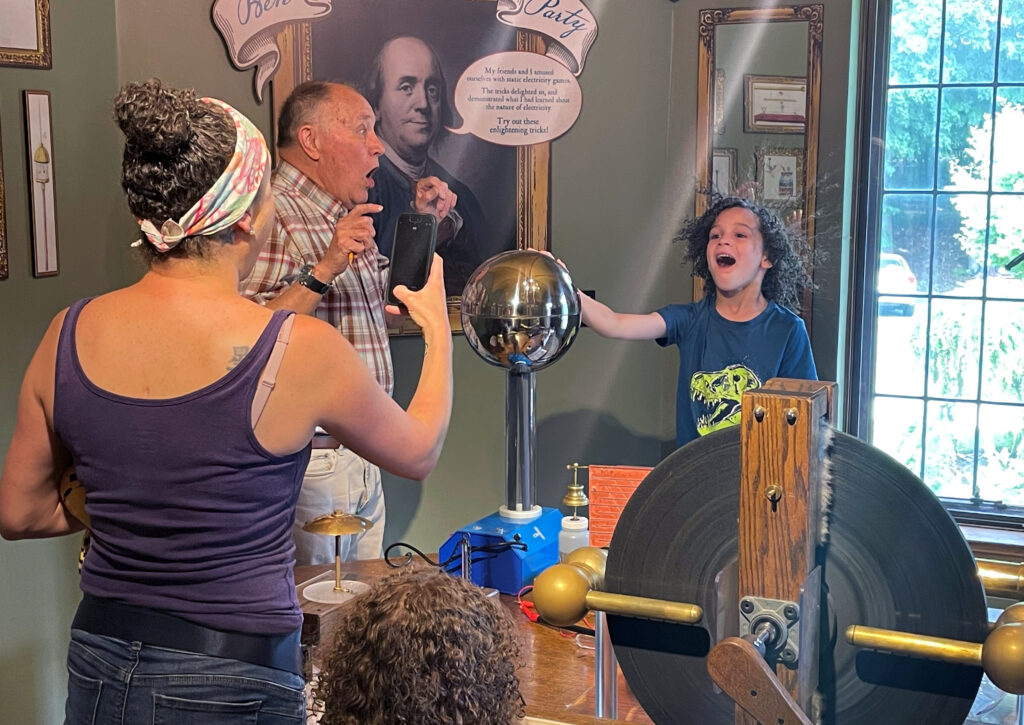
A child experiences static shock in an exhibit at The Bakken Museum (Courtesy of The Bakken Museum)
As a person who learns best by doing and experiencing, getting to visit so many museums in such a great museum city was extremely inspiring as I think about my next projects at The Bakken. Over the course of the four conference days, I managed to visit ten (!) museums. Some of my favorite kinds of museum visits are those where I get to have a multisensory experience. Although in my work I occasionally need to find kind and effective ways to convince visitors not to touch things, I know that that urge is always there (at least for me). That’s part of the reason I like working at The Bakken Museum. We can display a cool medical device behind plexiglass and tell you that it provides a shock to the heart, and then we can give you the opportunity to feel electricity flowing through your body and get a static shock, if that’s what you want to do! But there are more ways to bring in the senses than I even realized. Visual content in exhibits is, of course, standard practice, and audio is increasingly common, but touch, smell, and even taste can be included as well.
During the museum hops hosted every evening of the conference in Chicago, I loved seeing so many different kinds of sensory content included in exhibits. I learned about native flowers through art accompanied by touchable seed displays at the Peggy Notebaert Nature Museum. At the Field Museum, the putrid smell of a dinosaur’s breath gave me a whiff of the Cretaceous period. And the 1940s style candy I tasted during a tour of the National Public Housing Museum’s recreated historic apartment transported me into the world of the Turovitz family. The more frequent and more varied the multisensory experience is in an exhibit, the more ways there are for a visitor to connect with the truths held there – and remember and reflect on them later. I see these kinds of multisensory and participatory experiences as access points, or doors, through which visitors can find connection to the content of the exhibit.
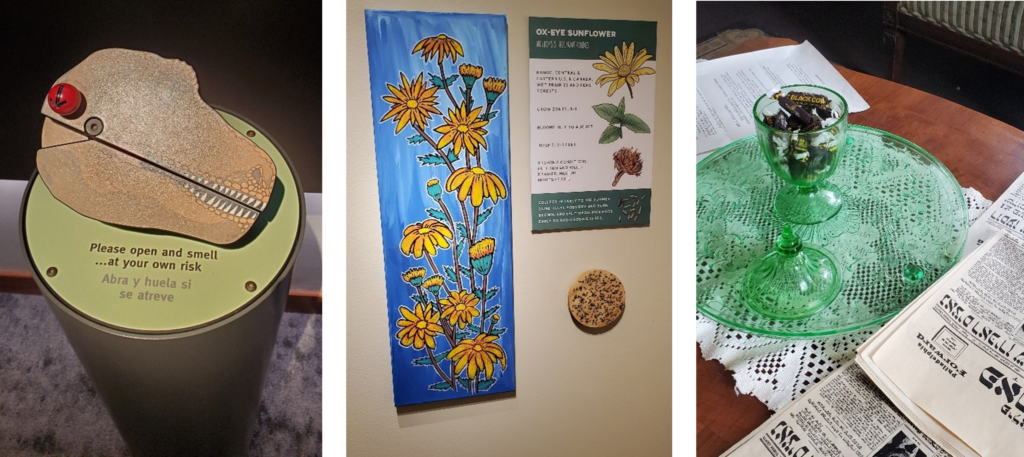
Three examples of sensory experiences at Chicago museums (Photos by Audra Johnson)
The idea of creating more doors (physical and metaphorical) for visitors to access experiences was prevalent throughout my conference experience.
To get people to approach a door to a museum experience it needs to be inviting and lead to a feeling of belonging on the other side. In the presentation, Inclusive by Design: Creating Access From the Start, Dr. Stephanie M. Lampkin from the Underground Railroad Freedom Center discussed how they increased that feeling of belonging by including community advisors from the early stages of developing their new permanent exhibit. Beginning with known accessibility needs, they were able to include accessible features in the first design concepts and worked to ensure that each vendor they contracted and each iteration of the project centered the needs of their community. In this way, aspects that are sometimes included as an afterthought and forced into a design were instead built into the concept itself.
The exhibits at The Bakken Museum, full of light, sound, and sometimes electricity, are great at stimulating the senses and creating memorable experiences, but may not always be inviting and accessible to everyone. While multisensory experiences can be positive for some, others will find them overwhelming. To guide our work in addressing these challenges, listening sessions will be an important tool. Listening sessions with community members have been used at The Bakken in the past, with encouraging results, and as thoughts begin to swirl about the Next Big Exhibit Idea for The Bakken Museum, planning will involve as many voices as possible from the start to ensure that the door to the experience is as inviting as possible from day one.
More voices included from the start will create a wider doorway to experience the truths held in museums. This applies to voices from outside an institution, such as community experts, as well as voices from inside the institution itself. In their presentation, Adaptations: Interdisciplinarity and the 21st Century Museum, staff of the Michigan State University Museum discussed how including voices from all departments within the museum made their museum better. The assumption that exhibits are the brainchild of a subject-expert curator, to be brought to life by the rest of the museum staff, is no longer true. Instead, representatives from all departments have a voice in every phase, from ideation to execution and evaluation – creating a “collaboratory” that makes the exhibit more representative and welcoming to more kinds of visitors.
I noticed parallels between the interdisciplinary nature of the MSU Museum and my own institution, where we focus on innovation but don’t limit that word to any one subject. We like to ask open-ended questions at The Bakken and know that ideas will change, grow, and improve by bringing in more and different perspectives. As with any idea, opening the door for input and contributions from more voices in the early phases of exhibit development, provide more entry points for visitors to connect to the truths held therewithin.
The Exhibitions Professionals Fellowship gave me an entry point to the broader museum world, where I discovered that the process and goals of exhibit development also involve building doors to invite more voices in. Museums are some of our society’s most trusted institutions and, as this year’s conference theme of “We Hold These Truths” acknowledges, contained within museums are the objects, stories, and experiences that ground us in our context, whether historical, cultural, natural, or technological. Whereas in the past exhibits may have been considered more of a window, allowing visitors a peek at truths that they may or may not understand or relate to, the sessions I attended, the many museums I visited, and the conversations I had throughout emphasized the need to turn those windows into doors, through which people can pass to activate their senses and become participants in and contributors to the truths held by museums.
Whereas in the past exhibits may have been considered more of a window, allowing visitors a peek at truths that they may or may not understand or relate to, the sessions I attended, the many museums I visited, and the conversations I had throughout emphasized the need to turn those windows into doors, through which people can pass to activate their senses and become participants in and contributors to the truths held by museums.